Exposing the Long-tail in Embodied Urban Navigation via Scalable Learning from In-the-Wild Videos
The authors present a framework that trains vision-language-action policies for urban navigation from automatically annotated egocentric web videos while characterizing and diagnosing long-tail...
1. Introduction: The Danger of Aggregate Metrics in Urban Navigation
Operating autonomous mobile agents in unconstrained urban environments presents severe safety challenges. Unlike indoor environments with static boundaries or structured roadways governed by lane markers and explicit traffic signals, open urban spaces are characterized by dense pedestrian interactions, irregular traversable boundaries, and implicit social conventions. To operate safely, vision-language-action (VLA) navigation policies must interpret subtle visual cues, anticipate dynamic human motion, and select appropriate geometric paths in real time.
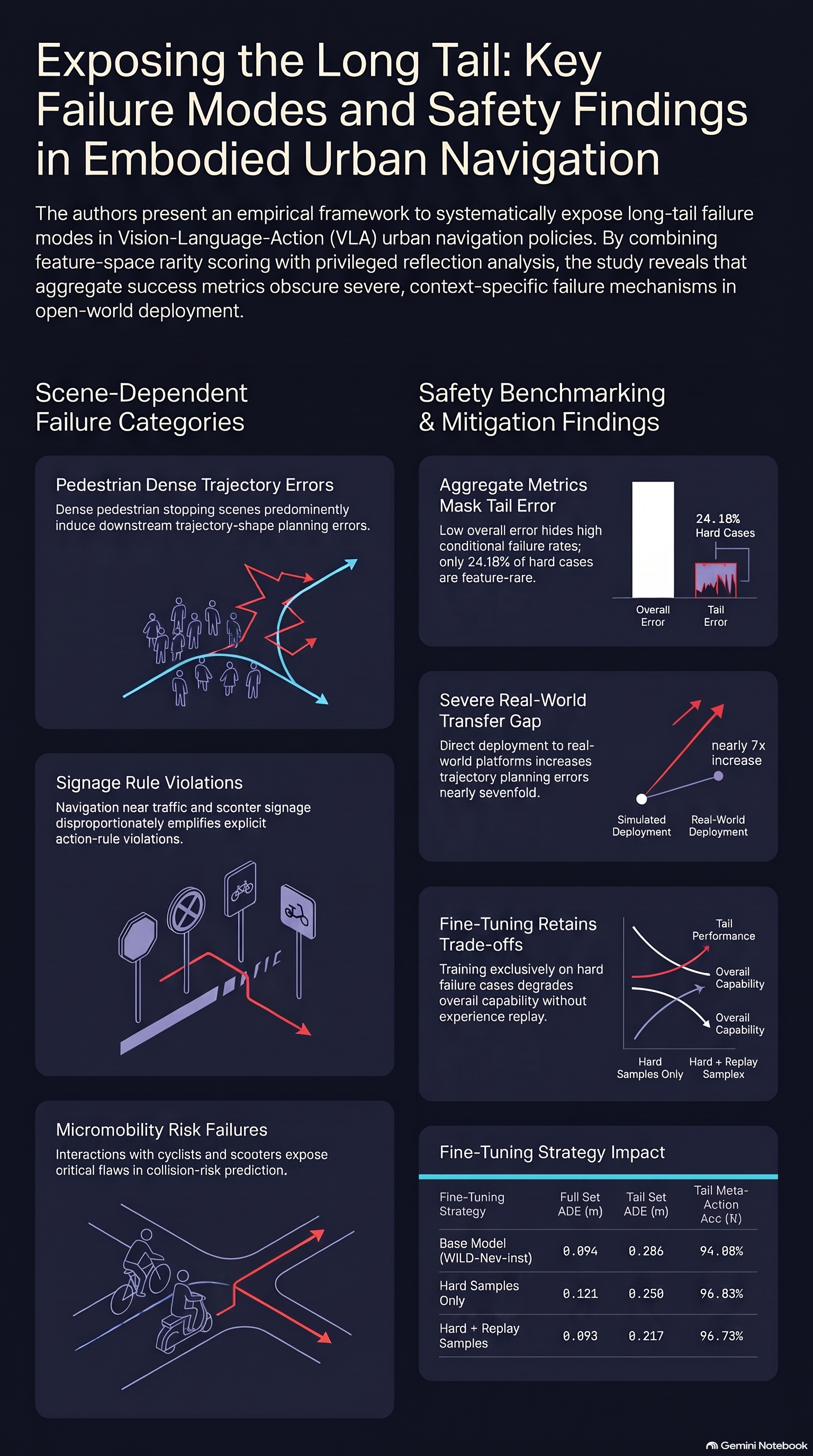
However, standard embodied navigation benchmarks evaluate models primarily through aggregate metrics, such as mean success rate or average trajectory error. These summary statistics mask rare, safety-critical failures occurring in long-tail scenarios. A policy can achieve high overall performance across typical sidewalk walking conditions while failing catastrophically when encountering complex edge cases—such as congested pedestrian bottlenecks, ambiguous boundary spaces, or poor visibility.
“Learning embodied urban navigation policies from real-world data is constrained by the cost of task-specific data collection and the limited coverage of rare yet safety-critical scenarios.” — Xia et al.
To address these vulnerabilities, research by Xia et al. (arXiv:2608.16476) introduces a framework to scale point-goal urban navigation using approximately 500 hours of uncurated street-walking videos while systematically exposing long-tail failure modes. By combining large-scale video processing with reflection-based diagnostic mechanisms, the authors demonstrate how in-the-wild web data can be leveraged to discover and audit safety bottlenecks in embodied AI models.
2. Solving the Data Bottleneck: From Web Videos to Navigation Episodes
Traditional data collection strategies for embodied navigation suffer from fundamental trade-offs:
- Robot Teleoperation: Real-world robot demonstrations capture actual physical dynamics but are severely constrained by expensive hardware collection and limited geographic diversity.
- Simulation: Synthetic environments allow automated generation of ground-truth labels at scale but retain a pronounced sim-to-real domain gap and depend on simplified predefined interaction rules.
- In-the-Wild Egocentric Web Videos: Human walking videos capture diverse, naturally occurring open-world environments globally, providing a scalable source of supervision that incorporates broad variations in weather, lighting, crowd density, and urban infrastructure.
To unlock this data source, Xia et al. constructed an automated data curation pipeline capable of transforming raw, uncurated web video into structured navigation training episodes. The resulting dataset expands geographic and semantic diversity significantly beyond existing benchmarks.
| Dataset Name | Duration | Location Diversity | Annotation Scheme |
|---|---|---|---|
| SCAND | 8.7 h | 1 Location | - |
| SiT | 0.4 h | 1 Location | 3D tracks and semantic maps |
| GND | 11 h | 10 Locations | Semantic map |
| Citywalker | 200 h | 1 Location (New York) | Caption and instruction |
| Ours (Xia et al.) | 500 h | 30 Cities (15 Countries) | Navigation reasoning CoT |
Automated Video Processing Pipeline
The pipeline processes raw street-walking videos into over 500,000 navigation samples through a three-stage automated workflow:
- Filtering: Uncurated web videos contain content outside the scope of ground-plane navigation. The authors employ a vision-language model (VLM) to detect video cuts, subject-focused clips, and non-ground-plane transition events (such as stairways, elevators, and doorways), systematically removing them from the dataset.
- Trajectory Reconstruction: To estimate metric trajectories without localized sensor telemetry, the pipeline utilizes the Pi3X visual geometry backbone within the LoGeR long-context reconstruction framework. Pi3X estimates camera poses and metric-scale depth per frame, while LoGeR maintains geometric consistency across overlapping chunks. Camera centers are projected onto an initial ground-plane reference frame to extract continuous walking paths. The reconstructed clips are sampled at 1 Hz and divided into 10-frame navigation episodes (consisting of 5 historical observation frames and 5 future ground-truth target waypoints).
- Semantic & Chain-of-Thought (CoT) Annotation: Grounded object perception is initialized using GroundingDINO to detect open-vocabulary 2D bounding boxes of navigation-relevant entities. These 2D bounding boxes are subsequently fused with 3D metric depth estimates derived from the Pi3X visual geometry backbone, mapping spatial entities into normalized object categories, image-plane coordinates, and metric depth labels. Next, a Qwen3.6VL-27B teacher model generates structured Chain-of-Thought (CoT) navigation rationales adhering to a formal perception-analysis-planning schema. During annotation, the teacher model receives historical/current visual inputs and the point goal as observable evidence, alongside privileged future frames used strictly for output verification to prevent future information leakage into the reasoning traces.
3. Architecture of WILD-Nav: Reasoning-Aware Policy Design
Using the curated web-scale dataset, Xia et al. trained WILD-Nav, a reasoning-aware VLA model designed for point-goal urban navigation. The policy translates high-level semantic reasoning into low-level continuous waypoint control.
Visual Inputs (It, Ihist) + Trajectory History (τhist) + Goal (gt)
                          │
                          ▼
            [ Frozen Visual Encoder ]
                          │
                          ▼
            [ Qwen3.5VL-4B LLM Backbone ] ──► Generates CoT Reasoning
                          │
                 <PLAN_QUERY> Token
                          │
             ┌────────────┴────────────┐
             ▼                         ▼
   [ Meta-Action Head ]       [ Trajectory Head ]
   (Linear Classifier)          (4-Layer MLP)
             │                         │
             ▼                         ▼
   Discrete Class (1 of 20)    5-Waypoint Plan (τplan)
Model Architecture & Backbone
- Language-Vision Backbone: WILD-Nav utilizes a Qwen3.5VL-4B vision-language backbone. The visual encoder processes five sequential egocentric RGB frames () into visual tokens, interleaved with textual representations of historical ground-plane trajectories () and local point goals (). The visual encoder remains frozen during training.
- Reasoning Interface & Execution Modes: Metric action control is interfaced via a special
<PLAN_QUERY>token. Xia et al. evaluate two execution modes for this token:- Reasoning-Conditioned Mode (Primary): The model autoregressively generates its full perception-analysis-planning CoT rationale first (\text{rationale} \rightarrow \text{`<PLAN_QUERY>`} \rightarrow \text{action}). The
<PLAN_QUERY>token is appended after text generation, allowing its normalized hidden state to aggregate the visual tokens and preceding reasoning trace before conditioning the action heads. - Direct Decoding Mode (Efficiency-Oriented): The
<PLAN_QUERY>token is placed before the rationale during training (<PLAN_QUERY>action). Causal attention masking prevents<PLAN_QUERY>from observing subsequent rationale tokens, enabling direct single-pass planning inference while retaining the rationale as an auxiliary training objective.
- Reasoning-Conditioned Mode (Primary): The model autoregressively generates its full perception-analysis-planning CoT rationale first (\text{rationale} \rightarrow \text{`<PLAN_QUERY>`} \rightarrow \text{action}). The
Action Expert Output Heads
The action expert extracts the normalized hidden state to decode qualitative intent and quantitative metric trajectories simultaneously:
-
Meta-Action Head: A linear classification layer predicting a discrete meta-action distribution:
- : Predicted probability distribution across 20 discrete meta-action classes (derived from speed, lateral progress, and motion direction rules).
- : Normalized hidden state associated with the
<PLAN_QUERY>token. - : Learnable weight matrix of the linear layer.
- : Learnable bias vector of the linear layer.
-
Trajectory Head: A multi-layer perceptron decoding into continuous future waypoints:
- : Predicted continuous short-horizon trajectory consisting of 5 discrete future waypoints.
- : Predicted egocentric ground-plane positional coordinates for step .
- : 4-layer MLP architecture containing three 512-dimensional hidden layers with GELU activation functions.
Multi-Task Loss Formulation
WILD-Nav is trained end-to-end using a joint multi-task loss objective combining three complementary components:
- Autoregressive CoT Loss (): Standard cross-entropy loss computed over generated rationale tokens ():
- Meta-Action Loss (): Cross-entropy loss supervising discrete meta-action classification against rule-derived ground-truth labels ():
- Trajectory MSE Loss (): Mean Squared Error measured across the five projected metric waypoints against reconstructed ground-truth positions ():
4. Exposing the Long Tail: Joint Rarity, Hardness, and Privileged Reflection
A primary focus of Xia et al.’s work is moving beyond predefined scenario taxonomies (such as “jaywalkers” or “construction sites”) to discover naturally occurring long-tail navigation failures directly from empirical data.
Disentangling Distributional Rarity and Model Hardness
The authors establish that long-tail safety vulnerabilities depend on two distinct metrics that overlap but are not identical:
- Distributional Rarity (Perception-Motion Pattern Rarity): Evaluated by calculating feature-space density across normalized spatial perception representations (object classes, bounding boxes, depth) combined with geometric motion patterns. Rare samples represent unusual environment-action combinations in the empirical training distribution.
- Model Hardness: Evaluated by measuring model-dependent trajectory prediction errors on specific samples during policy execution.
The authors note that high aggregate benchmark accuracy often obscures severe conditional errors concentrated within these rare or difficult subpopulations.
3-Step Long-Tail Mining & Attribution Methodology
To isolate and understand these failure modes, Xia et al. implement a structured three-step discovery process:
- Characterization: Construct a continuous feature space combining normalized perceptual object-depth features and motion parameters, establishing quantitative metrics for feature-density rarity and model planning error.
- Mining: Identify edge-case candidate episodes by querying the dataset for instances exhibiting high distributional rarity, high model-dependent trajectory error, or both simultaneously.
- Reflection-Based Attribution: Execute post-hoc failure attribution using an LLM/VLM teacher model configured with privileged reflection. The teacher receives the model’s generated CoT rationale, the predicted trajectory, and privileged future frames/ground-truth trajectories. The teacher evaluates whether the failure stemmed from visual perception errors, faulty scene analysis, or motion planning mismatches, assigning structured failure tags (
weak_visual_evidence,unreliable_bbox,ambiguous_motion,trajectory_mismatch,unsafe_path, orpoor_visibility) without leaking future data into training inputs.
The WILD-LongTail Benchmark
To facilitate standardized evaluation, Xia et al. curated the WILD-LongTail benchmark. It aggregates the identified rare and high-error navigation episodes alongside structured reflection labels, enabling researchers to benchmark model performance specifically against long-tail edge cases rather than aggregate success rates.
5. Takeaways for AI Red-Teamers and Safety Practitioners
The methodology and findings presented by Xia et al. offer several actionable insights for red-teaming and auditing embodied VLA models:
- Uncurated Web Scaling Requires Explicit Long-Tail Audit Pipelines: Expanding uncurated video volume increases broad coverage but does not automatically eliminate tail failures. Red-teamers cannot rely on aggregate validation metrics; safety audits must explicitly isolate low-density perception-motion feature clusters and high-error subpopulations.
- Structured Reasoning Traces Enable Stage-Specific Auditing: Decoupling executive planning into explicit Chain-of-Thought stages (perception analysis planning action tokens) allows auditors to pinpoint the root cause of physical failures. Red-teamers can isolate whether a dangerous trajectory originated from a visual grounding failure (
unreliable_bbox), a misinterpretation of social rules (unsafe_path), or a controller regression error (trajectory_mismatch). - Stage-Specific Attribution Directs Targeted Adversarial Testing and Resampling: Identifying the exact stage where reasoning breaks down enables targeted intervention. If failure tags highlight visual grounding vulnerabilities, safety teams can construct focused adversarial visual prompts; if failures stem from risk analysis, fine-tuning datasets can be resampled specifically around high-hardness decision boundaries.
- Privileged Reflection Automates Diagnostic Failure Taxonomies: Utilizing stronger teacher models supplied with post-hoc privileged ground truth provides a scalable mechanism for auditing model failure modes, replacing arbitrary manual taxonomy construction with data-driven diagnostic tagging.
- Decoupled Evaluation Benchmarks are Essential for Embodied Audits: Standardizing benchmark splits like WILD-LongTail—which evaluate agents specifically on rare perception-motion configurations and high-hardness boundaries—provides a more rigorous standard for real-world deployment readiness than summary statistics on standard test sets.
Read the full paper on arXiv · PDF